Feeder fishing
Related gear
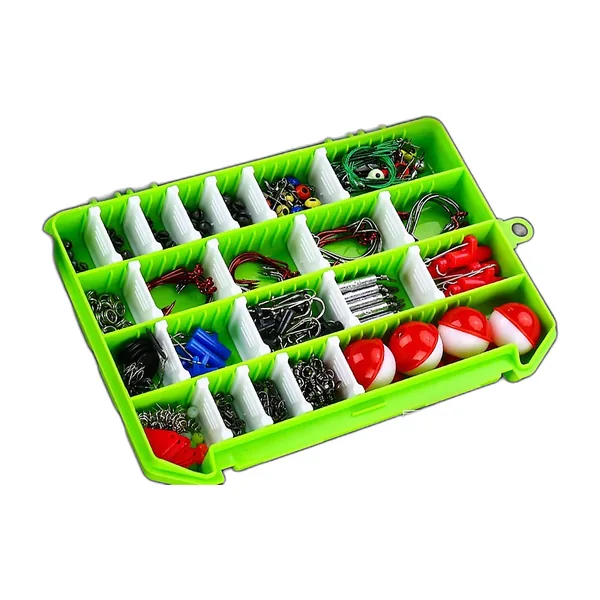 Fishing Accessory Box, 329 Pieces
Suited to: Common carp.
€45.90£25.90Not shipped to the United States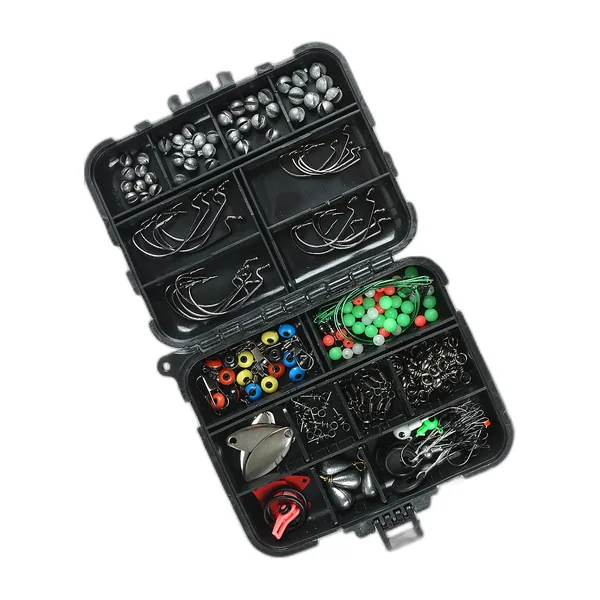 Box of 188 Fishing Accessories
Suited to: Common carp.
€32.90£17.90Not shipped to the United States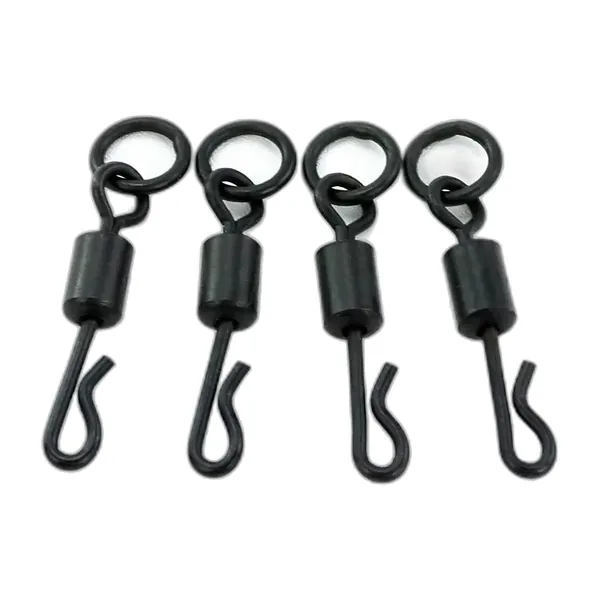 Carp Rig Kit: Ring Swivels, Pop-Up Beads, Shrink Tube
Suited to: Common carp.
€42.90£24.90Not shipped to the United States
The idea
Feeder fishing is bottom fishing where the feed travels with the rig: a small cage or container, the feeder, is filled with groundbait, maggots or pellets and cast to exactly the same spot every time. The hookbait lies a short distance away, right in the middle of the feed. Bites show on a sensitive quivertip. It is the go-to method for bream, barbel, tench and average-sized carp, on rivers and stillwaters alike, and a mainstay of UK match fishing.
Tackle
A feeder rod with several quivertips of different strengths; a reel with a line clip to fix the distance; mono or braid, with a shock leader for heavy casting; a selection of feeders (cage feeders for groundbait, block-end feeders for maggots on rivers, method feeders with feed moulded around the hookbait); and hooks matched to the bait, ideally barbless.
Accuracy first
The secret is accuracy. Pick a marker on the far bank, cast, clip up, and put every cast on the same spot. A few heavily loaded feeders at the start build the swim; after that, recast every few minutes. On rivers, a feeder heavy enough to hold bottom is essential; on stillwaters, the method feeder is often the quickest way to a bite.
Reading bites
A positive pull round: strike. Repeated small taps: wait. A tip that suddenly springs back: a fish has moved the feeder towards you, so wind down and strike. A tip that is too stiff hides delicate bites; one too soft moves with every bit of flow.
Sensible feeding
Arlinghaus and Niesar (2005) measured the digestibility of carp baits and groundbaits and discussed their role in eutrophication. Excess feed degrades the water and does not catch more fish. Match the amount to the number of fish in front of you.
Safe rigs and fish care
Use rigs that let the feeder come free if the line breaks, so no fish is left tethered. For big fish, bring a suitable net and an unhooking mat. If you use a keepnet, Pottinger (1998) is a reminder that retention causes measurable stress, so keep it short. In England and Wales, check how many rods your licence covers and the close season on rivers; elsewhere, check the regulation page for your area.
The gear, item by item
- Feeder rod with interchangeable quivertips
- Reel with a line clip to repeat the distance
- Mono or braid with a shock leader for heavy casts
- Cage, open-end, block-end and method feeders
- Hooks matched to the bait, ideally barbless
- Groundbait and pellets to fill the feeder
- Maggots, casters, worms, sweetcorn, pellets
- Net sized for the biggest fish you expect
- Unhooking mat for carp and barbel
Step by step
- Pick a far-bank marker so you always cast in the same line.
- Make a first cast and clip up to fix the distance.
- Cast several heavily loaded feeders to the same spot to build the swim.
- Bait up, fill the feeder and recast every few minutes.
- Tighten up and watch the quivertip for pulls, taps and drop-backs.
- Strike with a smooth sweep.
- Net, unhook and recast to the same spot.
Common mistakes
- Casting to different distances so the feed spreads out.
- A tip that is too stiff and hides bites.
- Unsafe rigs: the feeder must be able to come free if the line breaks.
- Too much feed on a small water.
- Leaving rods unattended where big fish can drag them in.
Rules to check before you go
- Number of rods allowed.
- Bait and groundbait restrictions on some fisheries.
- Keepnet rules.
- Night fishing rules.
- Size and bag limits.
Fishing regulations by country
Frequently asked questions
What is feeder fishing and how does it work?
Feeder fishing is a coarse-fishing method in which a small cage or method feeder filled with groundbait, maggots or pellets is cast to the same spot every time, placing the hookbait in a bed of feed. Bites show on a sensitive quivertip. It is ideal for bream, roach, tench, barbel and carp in rivers and lakes.
In feeder fishing, the feed travels with the rig. A feeder, which can be an open-end or cage feeder for groundbait, a closed block-end feeder for maggots in rivers, or a method feeder with feed moulded around it, is filled and cast to exactly the same spot each time, releasing its contents on the bottom next to the short hooklink and bait. The angler uses a feeder rod with interchangeable quivertips of different stiffness, which act as bite indicators, and a reel with a line clip to repeat the same distance. Casting accurately to a far-bank marker and clipping up is the key skill; a few loaded casts build the swim, then regular recasting keeps fish feeding. Baits include maggots, casters, worms, corn and pellets. A sharp pull on the tip means strike; repeated small taps mean wait; a tip that springs back indicates a fish has moved the feeder towards you. Feed moderately: Arlinghaus and Niesar (2005) measured the digestibility of angling baits and discussed their contribution to nutrient loading. Use rigs that release the feeder if the line breaks. In England and Wales, rivers are closed to coarse fishing from 15 March to 15 June (GOV.UK).
Official sources : Arlinghaus & Niesar 2005 – Nutrient digestibility of angling baits for carp (Fish. Manag. Ecol.) ; GOV.UK – Freshwater rod fishing rules: when and where you can fish
What is a feeder fishing rod used for, and which is best?
A feeder rod is a ledger rod with interchangeable quivertips that show bites, designed to cast a feeder full of bait accurately and repeatedly. The best rod depends on the venue: light rods for small feeders on commercial lakes, medium rods for general use, heavy rods for long casts and big river feeders. No official standard defines the best model.
Feeder rods are built for one job: casting a loaded feeder to the same spot again and again and showing bites on a sensitive tip. They usually come with several push-in quivertips of different test ratings; a softer tip shows delicate bites in still water, a stiffer one copes with river current or heavier feeders. Rods are typically described by length and casting weight; longer, more powerful rods cast heavier feeders further and handle strong flows and big fish such as barbel, while shorter, lighter 'picker' or method rods suit small feeders and short range on commercial fisheries. There is no official or scientific standard defining the best feeder rod, so the choice follows the venue: consider typical casting distance, feeder weight, current and the size of fish. Pair the rod with a reel that has a line clip and a smooth drag, suitable main line, and a landing net big enough for the largest expected fish. Keep feeding moderate; Arlinghaus and Niesar (2005) highlighted the nutrient load that angling baits add to waters. In England and Wales the distance between the butts of the outermost rods must not exceed 3 metres when fishing with multiple rods (GOV.UK).
Official sources : Arlinghaus & Niesar 2005 – Nutrient digestibility of angling baits for carp (Fish. Manag. Ecol.) ; GOV.UK – Freshwater rod fishing rules: tackle you can use
What line is best for feeder fishing, including braid?
Most feeder anglers use a fine monofilament main line for general fishing because its stretch cushions strikes and fights, and switch to braid for long casts and better bite detection at range, often with a shock leader to take casting loads. Strength depends on feeder weight and fish size. No official standard or study ranks lines.
There is no scientific ranking of feeder lines, so this answer explains the trade-offs. Monofilament is the common choice at short to medium range: it stretches, which reduces hook pulls with fine hooklinks and fish such as bream and roach, and it is forgiving when fish lunge near the net. Sinking mono keeps the line below surface drift. Braid, which has almost no stretch, transmits bites instantly at long range and casts further for a given strength, which is why many anglers use it on big lakes and wide rivers; it can, however, make hook pulls more likely close in, so a mono or fluorocarbon shock leader is often added. A shock leader of heavier line is also used when casting heavy feeders hard, because the load on the first metres of line during the cast is high, and a break sends the feeder flying dangerously. The main-line strength must match the feeder weight and the largest fish expected, with lighter hooklinks acting as the weak point so that a fish never breaks off with the feeder attached; rigs should let the feeder slide off if the line breaks. Arlinghaus and Niesar (2005) reminded anglers to feed moderately, since baits add nutrients to the water. Check fishery rules, which sometimes ban braid.
Official sources : Arlinghaus & Niesar 2005 – Nutrient digestibility of angling baits for carp (Fish. Manag. Ecol.)
What reel should you use for feeder fishing?
Use a fixed-spool reel with a reliable line clip to repeat casting distance, a smooth front drag, and a spool size suited to your casting range and line; many feeder anglers choose reels in the medium sizes common for coarse fishing. No official standard defines the best reel, and sizing differs between brands.
Feeder fishing depends on repeating the same cast accurately, so the most important reel feature is a strong, well-placed line clip that stops the line at the chosen distance. Beyond that, look for a smooth front drag that gives line to hard-fighting fish such as barbel, tench and carp without jerking, a spool that lays line evenly for long casts, and a retrieve ratio that lets you wind in quickly between casts. A larger spool casts further and handles heavier lines for big rivers and long-range lake fishing; a smaller, lighter reel balances a light picker or method rod for short range. Reel sizes are not standardised across manufacturers, so there is no official size to recommend; choose one that balances with your rod and holds enough of your chosen line. We found no scientific study on reel choice, so this answer reflects practical requirements rather than measured data. Pair the reel with suitable line, a shock leader when casting heavy feeders, and a landing net for the largest expected fish. Keep feeding moderate, as Arlinghaus and Niesar (2005) showed that baits add nutrients to the water, and follow rules on rod numbers and spacing, such as the 3-metre limit between outer rod butts in England and Wales (GOV.UK).
Official sources : Arlinghaus & Niesar 2005 – Nutrient digestibility of angling baits for carp (Fish. Manag. Ecol.) ; GOV.UK – Freshwater rod fishing rules: tackle you can use
When should you strike when feeder fishing?
Strike when the quivertip pulls round firmly or when it springs back sharply, which means a fish has moved the feeder towards you. Small, repeated taps are often line bites or fish moving around the feed, so wait for a positive movement. With the method feeder, bites are usually sharp and self-hooking. This is common practice, not a studied rule.
Bite reading on the feeder is learned mostly by experience, and we found no scientific study that sets rules for when to strike, so this answer reflects widely used practice. A confident pull that bends the quivertip steadily round is the classic bite: strike with a smooth sweep of the rod. A 'drop-back', when the tip suddenly springs straight, indicates a fish has picked up the bait and moved the feeder towards the bank; reel in any slack quickly and strike. Small, rapid knocks or rattles are often fish brushing the line or moving over the feed; striking at these usually misses, so wait for a clearer indication, unless small fish such as roach are stripping maggots. With the method feeder and short hooklinks, bites are often violent and the fish hooks itself against the weight of the feeder, so simply lift into it. In strong current, choose a tip stiff enough to hold the feeder without constant movement, or a heavier feeder. Striking promptly also reduces the chance of fish swallowing the hook, which Muoneke and Childress (1994) identified as a major cause of mortality in released fish. Unhook quickly with a disgorger and return fish carefully, keeping retention in keepnets short (Pottinger 1998).
Official sources : Muoneke & Childress 1994 – Hooking mortality: a review for recreational fisheries (Rev. Fish. Sci.) ; Pottinger 1998 – Cortisol, glucose and lactate in carp retained in keepnets (J. Fish Biol.)
Is feeder fishing good in winter?
Yes, feeder fishing can be very effective in winter, especially for roach, skimmers and chub, if you feed much less, scale down baits and hooks and fish deeper, sheltered areas. English and Welsh rivers are open to coarse fishing in winter; their close season runs from 15 March to 15 June.
Cold water slows fish metabolism, so they feed less, but they still feed, and the feeder is a precise way to put a small amount of bait exactly where fish are holding. Roach, according to our species data based on FishBase, bite all year and the biggest roach are often caught in autumn and winter, when they gather in deeper, slower water; FishBase notes that in fast rivers roach need backwaters and sheltered stretches to overwinter. Winter tactics: use small feeders or maggot feeders and feed sparingly, because overfeeding fills fish that eat little; scale down to single or double maggot, a small piece of bread or a small pellet on a fine hook; look for deeper areas, marinas, sheltered bays and slack water on rivers; and fish longer hooklinks for cautious fish. Tench and carp are less active in cold water, so catches are more likely from roach, skimmers, perch and chub. Rules: in England and Wales, winter falls outside the river close season for coarse fish, which runs from 15 March to 15 June, and most stillwaters and canals are open all year subject to byelaws (GOV.UK). Handle fish carefully in cold weather and keep them out of freezing air.
Official sources : FishBase – Rutilus rutilus (Rotauge) ; GOV.UK – Freshwater rod fishing rules: when and where you can fish
Is feeder fishing a form of coarse fishing?
Yes. Feeder fishing is one of the main coarse-fishing methods in Britain and Ireland, used for species such as bream, roach, tench, barbel, chub and carp. It is therefore subject to coarse-fishing rules, such as the river close season from 15 March to 15 June in England and Wales and daily limits on coarse fish.
In British and Irish usage, coarse fishing means fishing for freshwater species other than salmon and trout, such as roach, bream, tench, barbel, chub, carp, perch and pike. Feeder fishing, which uses a feeder to place bait around the hookbait and a quivertip to show bites, is one of the most widely used coarse-fishing methods, alongside float fishing, pole fishing and specialist carp fishing. The distinction matters because rules are often defined by the type of fish. In England and Wales, you cannot fish for coarse fish on rivers from 15 March to 15 June; during that period you may fish for game fish such as trout on rivers, but with bait and lure restrictions in some regions (GOV.UK). Daily limits on rivers include up to 15 small coarse fish up to 20 cm, among them barbel, chub, bream, carp, perch, roach, rudd and tench, and fish you cannot keep must be returned unharmed (GOV.UK). In Ireland, Inland Fisheries Ireland summarises that no coarse fish over 25 cm may be killed and only four may be kept per day. Feeder methods can also catch game fish such as trout when used where that is allowed, but the method itself is rooted in coarse fishing.
Official sources : GOV.UK – Freshwater rod fishing rules: when and where you can fish ; GOV.UK – Freshwater rod fishing rules: fish size and catch limits ; Inland Fisheries Ireland – Angling regulations reminder (pike bye-law 809/2006, coarse fish bye-law 806/2006)
What is the best method feeder approach for beginners?
For beginners, a simple method feeder rig on a commercial or club lake works well: an inline method feeder, a short hooklink with a small hair-rigged pellet or corn, damp groundbait or micro pellets pressed around the feeder, cast to one spot and recast every few minutes. Fish tend to hook themselves. No study ranks setups.
The method feeder is popular with beginners because it is simple and often self-hooking. The usual setup is an inline flat or classic method feeder that slides on the main line, a short hooklink of a few inches with a small hook, and a hookbait such as a pellet, sweetcorn or a small boilie on a hair or bait band. Press dampened groundbait or soaked micro pellets around the feeder using a mould, push the hookbait into the feed, and cast to the same spot each time using a line clip and a far-bank marker. Recast every few minutes at first to build a small bed of feed, then less often as bites come. Because the hooklink is short and the feeder heavy, carp, tench and bream usually hook themselves; lift firmly into the fish. Use a sensitive feeder rod, a landing net and, for big carp, an unhooking mat. We found no study ranking method-feeder setups, so this reflects common practice. Choose rigs that let the feeder come free if the line breaks, feed moderately because Arlinghaus and Niesar (2005) showed baits add nutrients to waters, and check fishery rules, some of which specify barbless hooks or ban certain baits.
Official sources : Arlinghaus & Niesar 2005 – Nutrient digestibility of angling baits for carp (Fish. Manag. Ecol.)
What hooks are best for feeder fishing?
Choose hooks matched to the bait and fish: fine-wire hooks for maggots and casters for roach and skimmers, slightly stronger wide-gape hooks for pellets, corn and bigger fish such as bream, tench and carp, and barbless or micro-barbed patterns where fisheries require them. No official standard or study defines the best hook.
Hook choice follows two rules: the hook must suit the bait so that the point stays exposed and the bait behaves naturally, and it must be strong enough for the largest fish likely to be hooked. For maggots and casters aimed at roach and skimmers, small fine-wire hooks let the bait move naturally and penetrate easily. For pellets, sweetcorn and worms and for bigger fish such as bream, tench, barbel and carp, stronger hooks with a wider gape are used, often with a hair or bait band so the point stays clear. Many commercial fisheries require barbless or micro-barbed hooks, which also speed unhooking. We found no official standard or study that ranks feeder hooks, so this reflects common practice. Fish welfare adds guidance: Muoneke and Childress (1994) identified deep hooking as a major cause of mortality in released fish, so strike promptly and use a disgorger; Czarkowski and Kapusta (2019) found in float fishing that angler experience affected efficiency with different hook types as much as the hooks themselves. In England and Wales, fish that are foul-hooked must be returned alive (GOV.UK). Keep hooks sharp and replace damaged ones.
Official sources : Muoneke & Childress 1994 – Hooking mortality: a review for recreational fisheries (Rev. Fish. Sci.) ; Czarkowski & Kapusta 2019 – Angling experience and float fishing efficiency with different hooks (Fish. Aquat. Life) ; GOV.UK – Freshwater rod fishing rules: tackle you can use
What is the best feeder fishing setup?
A versatile feeder setup is a feeder rod with several quivertips, a fixed-spool reel with a line clip, mono or braid main line, a running or paternoster rig with a cage, maggot or method feeder, a short to medium hooklink, and hooks matched to the bait. Adjust feeder weight and tip to the current and distance.
There is no single best setup, and we found no study ranking them, so this describes a versatile starting point. Rod: a feeder rod with interchangeable quivertips, light for still water and small feeders, stronger for rivers and long casts. Reel: a fixed-spool reel with a reliable line clip and smooth drag. Line: monofilament for most situations, braid for long range, with a shock leader when casting heavy feeders. Rig: a running feeder rig, a helicopter or a paternoster, all designed so the feeder can come free if the line breaks, or an inline method feeder for carp and tench on commercial lakes. Feeders: open cage feeders for groundbait, block-end feeders for maggots in rivers, method feeders for pellets and groundbait. Hooklink and hook: finer and longer for wary roach and bream, shorter and stronger for carp and tench. Accessories: a landing net, a disgorger, an unhooking mat for big fish and, where allowed, a keepnet that meets legal design rules, such as knotless mesh and a minimum length of 2 metres in England and Wales (GOV.UK). Feed moderately, because Arlinghaus and Niesar (2005) showed baits add nutrients to the water, and read fishery rules on feeders, baits and hooks.
Official sources : GOV.UK – Freshwater rod fishing rules: tackle you can use ; Arlinghaus & Niesar 2005 – Nutrient digestibility of angling baits for carp (Fish. Manag. Ecol.)
Studies cited
- Arlinghaus & Niesar (2005) Nutrient digestibility of angling baits for carp, Cyprinus carpio, with implications for groundbait formulation and eutrophication control Fisheries Management and Ecology doi:10.1111/j.1365-2400.2004.00425.x
Measures nutrient digestibility of carp baits and groundbaits and discusses their role in eutrophication: a case for sensible feeding. - Pottinger (1998) Changes in blood cortisol, glucose and lactate in carp retained in anglers’keepnets Journal of Fish Biology doi:10.1111/j.1095-8649.1998.tb01828.x
Measures stress in fish held in keepnets, common in match feeder fishing.